If you already know how to use information displayed in a voice-leading space just go ahead and follow this link to: An Expanded Voice-Leading Space for Trichords
Otherwise read the short introductory text below and when you feel comfortable with terms and procedures then follow the link.
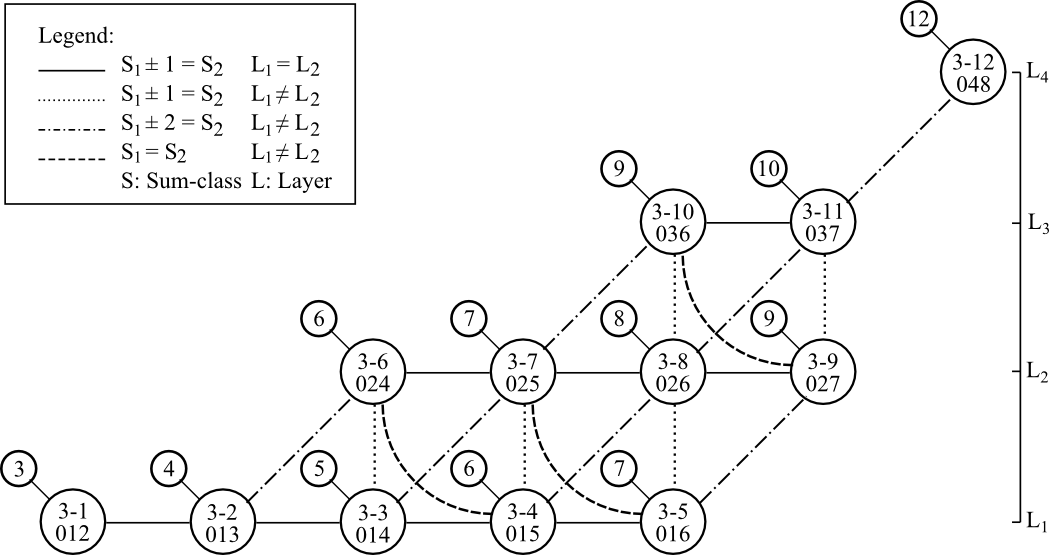
The main purpose of this application is to provide helpful information for composer when compiling pre-compositional material. Figure 1 shows a voice-leading space for trichords. It is slightly different from the one presented by Straus (2005, 111) after Morris (1998, 175-208). It was rotated 90 degrees to the left, it has sum-class numbers inside small circles attached to each set-class, it has layers numbers assigned to each row of set classes, and it has different line patterns connecting set classes.
|
As proposed here, such an expanded voice-leading space will have the following features: 1) it will use exclusively set classes prime forms, meaning it will be a OPTI system (see Callender 2008, and Tymoczko 2011), 2) it will not admit multisets, and 3) it will consider other operations besides those commonly used (for a more complex discussion on operations see Cook 2005).
Concerning connectors keep in mind that the first element is always zero and never changes, and that prime forms are dealt with here. Solid line connectors indicate one is moving forward or backward within the same layer – sum-class numbers differ by 1. Dotted connectors indicate one is moving upward or downward between layers – sum-class numbers also differ by 1. Diagonal dash-dotted connectors show one is moving between layers and simultaneously moving forward or backward – sum-class numbers differ by 2. Finally, curved dashed connectors imply one is also moving between layers but with a special operation. This last operation is not a traditional operation since it involves sets offset by two semitones. It is admitted here because involved set classes have equal sum-class numbers. This fact implies that they share interval-classes similarities as will be seen later (for a different and more in depth approach to sum-classes see Cohn 1998).
By definition the voice-leading space is created by placing in proximity set classes that are offset by one-semitone. For instance, C, C#, D, a member of set class 3-1 (012) and C, C#, D#, a member of set class 3-2 (013) are connected in the voice-leading space because the D in the first set is offset by only one semitone from the D# in the second set. There is more than one operation capable to connect the same pair of set classes. One will find all possible operations either following the link at the top of this page or in a printable file listed at the end of this page.
Besides providing smooth transitions from one set class to another the voice-leading space also allows for sharing of common interval-classes. Considerations on which and how many interval-classes are kept in common and quantity of intervals lose or gained when moving from one set class to another can be of great help in taking compositional decisions. One will find all about interval-classes sharing and changing either following the link at the top of this page or in a printable file listed at the end of this text.
Be careful when making operations. Keep in mind that some operations are not cumulative. It means, some operations will invert the current set and if one applies an operation on an inversion, the operation may or may not result in the desired direction. So, make sure you perform operations on prime forms keeping track of resulting transpositions or inversions, and always put results in normal forms. Basic procedures illustrated with sample examples are provided in Table 1 and 2 below. In the tables letter A stands for 10 and B stands for 11. Letter E, standing for Element, is followed by numbers representing the order of elements inside sets, and plus or minus signs meaning addition or subtraction of one semitone to previously assigned member. For instance, E2+ means: add one semitone to the second element of the set.
| Procedure | Example | Operations | Results | Comments |
|---|---|---|---|---|
| Start by choosing any set class either in prime form or transposed, or even inverted. Let's choose the prime form of set class 3-1 (012). | 0 1 2 | E1- | B 1 2 | Starting set was in prime form: 3-1 (012) and resulting set: [B, 1, 2] is T2I of 3-2 (013). |
| Take note that you ended with a T2I of the original set. Now, if you apply the next operation on the current set you will end up with an incorrect result. Let´s check this. Let´s assume you want to move from current set to set class 3-6 (024). | B 1 2 | E1- | A 1 2 | Set [A, 1, 2] is T2I of 3-2 (014). Although the result is valid (it is connected in the voice-leading space), that is not what you were supposed to get. |
| To get the right result do as follows. Take the prime form of the current set. That is, take (014) (prime for of [A, 1, 2,]) and apply desired operation. | 0 1 4 | E1- | B 1 3 | Set [B, 1, 3] is T11 of 3-6 (024) and still is not what you want. But you know you are in the right place. |
| Remember that previously you were working with T2I. So now you must take T2I of the prime form of the current set [B, 1, 3] which is (2, 0, A). | 2 0 A | (put it in normal form) | A 0 2 | This is the correct result since [A, 0, 2] is T2I of set class 3-6 (024). |
Another situation is analyzed in Table 2.
| Procedure | Example | Operations | Results | Comments |
|---|---|---|---|---|
| Start by choosing any set class either in prime form or transposed, or even inverted. Let's choose [2, 4, 8] which is T2 of set class 3-8 (026). | 2 4 8 | E2+ | 2 5 8 | Starting set was T2 of set class: 3-8 (026) and resulting set: 2 5 8 is T2 of 3-10 (036). |
| Take note that you started and ended at T2. Now, let´s assume you want to move from current set [2, 5, 8] to set class 3-11 (037). Among 6 possible operations let's take E1- and E3+ and apply them to [2, 5, 8]. | 2 5 8 | E1- and E3+ | 1 5 8 and 2 5 9 | Both operations returned correct results. Set [1, 5, 8] is T8I of set class 3-11 (037), and [2, 5, 9] is T2 of the same set class. |
| You can either choose one of both results to apply the next operation. Let's take both and apply the same operation to check what happens. Assuming we want to move to set class 3-9 (027), let's use operation E2-. | 1 5 8 and 2 5 9 | E2- | 1 4 8 and 2 4 9 | Set [1, 4, 8] is T1 of set class 3-11 (037) and set [2, 4, 9] is T2 of set class 3-9 (027). While the second result is correct, the first one although valid is incorrect (it ended with a transposition of the same previous set). Why? The first operation was applied on an inversion while the second one on a transposition. To correct the result of the first operation, follow the procedure explained in Table 1. |
| Let's correct the first operation in short here (to get step by step instructions see Table 1). Take the prime form of set [1, 5, 8] which is (037), apply operation just to check you are in the right place, take T8I of the prime form (remember that this was the level of inversion you were working with), put the result in normal form and finally you have the right result. | 0 3 7 | E2- | 0 2 7, then T8I: 8 6 1, then normal form 6 8 1 | This is the correct result since set [6, 8, 1] is T8I of set class 3-9 (027). In this particular case it would be easier to compare the wrong and right results without using the normal form on the last operation. The wrong result was [1, 4, 8] and the correct one is [1, 6, 8]. |
I did not check all possible solutions to solve problems with operations because they proliferate very fast. So, take extreme care checking the results of operations you use. Since set theory involves a lot of calculations it is advisable that you download and install any computer assisted application. I use the PCN (Processador de Classes de Notas - Set Class Processor) developed by Brazilian Professor Dr. Jamary Oliveira (there is an English version). It can be freely downloaded at this page.
It is recommended that the user have the following files printed before moving to the next page (use A4 paper size).
Now you are ready to go ahead and follow this link to: An Expanded Voice-Leading Space for Trichords
Callender, Clifton, Ian Quinn, and Dmitri Tymoczko. 2008. “Generalized Voice-Leading Spaces.” Science 320: 346–348.
Cohn, Richard. 1998. “Square Dances with Cubes.” Journal of Music Theory 42, no. 2: 283–296.
_____. 2003. “A Tetrahedral Graph of Tetrachordal Voice-Leading Space.” Music Theory Online 9, no. 4: 1–19.
Cook, Robert C. 2005. “Parsimony and Extravagance.” Journal of Music Theory 49, no. 1: 109–140.
Straus, Joseph N. 2005. Introduction to Post-Tonal Theory. 3rd. ed. New York: Pearson.
Tymoczko, Dmitri. 2011. A Geometry of Music: Harmony and Counterpoint in the Extended Common Practice. Oxford: Oxford University Press.